If you're new to tarot and want to explore what the cards can reveal about love and relationships, you're in exactly the right place. This guide is for anyone who's curious, maybe a little intimidated, and ready to learn practical skills they can use right away—no mystical credentials required.
You don't need to memorize the whole deck before you start. You just need to know a few key cards, one solid spread, and how to listen to yourself. Tarot isn't about getting the "right" answer—it's about exploring what's happening beneath the surface of your love life. Let's get into it.
Essential Card Meanings for Love Readings
Some cards come up constantly in love readings. These are the ones you want to know cold—or at least, pretty well. Here's what the most common love-reading cards actually mean when they show up in your spread.
The Lovers (VI)
A major crossroads in a relationship—or the choice of one. This card often signals a significant decision about love: committing, choosing between two paths, or aligning your values with your heart. It can also represent deep harmony between two people.
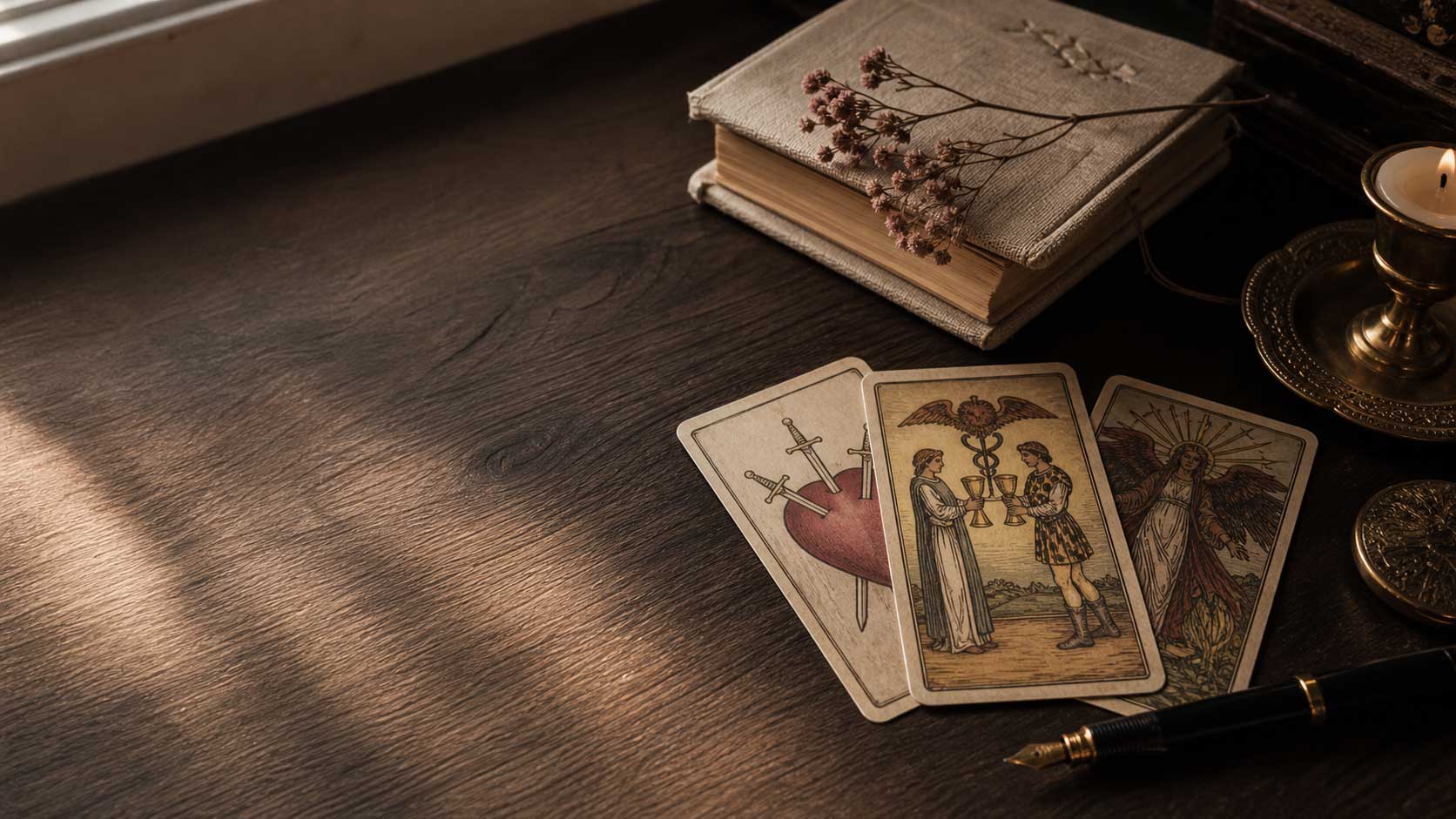
Two of Cups
One of the purest love cards in the deck. It represents mutual attraction, partnership, and emotional connection. When this card appears, it often means both people are genuinely into each other. New relationships frequently feature this card.
Ten of Cups
Emotional bliss, a happy family life, and deep contentment in a relationship. This is the card of long-term fulfillment—not the spark of new romance, but the warm glow of a love that has become home.
Three of Swords
Heartbreak, grief, or difficult emotional truths. It doesn't always mean something is broken—it can signal that something painful needs to be acknowledged before healing can begin. In a reading, it asks: what truth are you avoiding?
Five of Cups
Loss and regret, usually centered on what's been spilled rather than what remains. This card shows up when someone is stuck in disappointment. The hidden message: look at what's still whole. There's more available to you than what you've lost.
Eight of Cups
Walking away—not in anger, but in quiet acceptance that something isn't working. This card often appears when someone is ready to leave a relationship (or a phase of one), even if it's hard. It's about choosing your emotional wellbeing over clinging to the familiar.
The Moon (XVIII)
Illusion, intuition, and things beneath the surface. In love readings, The Moon can signal that not everything is as it seems—maybe there are unspoken feelings, hidden motivations, or self-deception at play. Trust your gut. The answer you feel is probably more accurate than the story you're telling yourself.
How to Phrase Your Love Question Correctly
This step is more important than most beginners realize. The way you phrase your question shapes the answer you get. Tarot reads best when you ask with genuine curiosity—not anxiety, not desperation, and not a fixed outcome in mind.
Instead of this
"Will [person] fall in love with me?"
Try this
"What do I need to understand about my feelings for [person] right now?"
Instead of this
"Is my ex going to come back?"
Try this
"What lesson from my past relationship do I still need to learn?"
Instead of this
"Should I stay in this relationship?"
Try this
"What does this relationship actually need from me right now?"
Open questions open doors. Closed yes/no questions usually just leave you more confused when the cards give you a nuanced answer you didn't expect. If you want to go deeper on this, our guide on phrasing tarot questions walks through more examples.
Basic 3-Card Love Spread: Step-by-Step Walkthrough
The 3-card spread is the workhorse of love tarot. It's simple enough to learn in minutes and flexible enough to answer almost any relationship question. Once you've practiced it a few times, it'll feel like second nature. If you want more layout options, check out our tarot spreads for beginners guide.
Card 1 — Your Energy
This card represents you—your emotional state, your attitude, and what you're bringing into the relationship right now. Are you open? Guarded? Anxious? This card tells you where you're starting from.
Card 2 — Their Energy
This card reflects the other person's current emotional state and perspective. It doesn't guarantee what they're thinking, but it gives you a read on the energy they're putting into the dynamic.
Card 3 — The Relationship Dynamic
The third card shows what's actually happening between you. This is often the most revealing card—the gap between Card 1 and Card 3 tells you a lot about how your personal energy is translating (or not) into the relationship.
Example reading: Card 1 (You) = The Moon. Card 2 (Them) = Two of Cups. Card 3 (Dynamic) = Five of Cups. You might be feeling uncertain (Moon), while they\'re showing genuine warmth (Two of Cups), but the overall dynamic is stuck in disappointment or a gap between expectations and reality (Five of Cups). The insight? Your anxiety might be creating a story that doesn\'t match what they\'re actually offering.
Interpreting Card Pairs and Contrasts
Once you can read individual cards, the next skill is seeing how they talk to each other. Two cards side by side create a conversation—and that conversation is usually more insightful than either card alone.
Cups + Cups = Strong Emotion
Two Cups cards together usually confirm that feelings are real and running deep. It can also mean emotions are overwhelming the situation. Look at which suit is "winning" the spread.
Wands + Pentacles = Passion vs. Practicality
This is a classic tension pair. Wands bring fire, excitement, and desire. Pentacles bring earth, stability, and realism. When they appear together in a love reading, the question is often: are these two people on the same page about what they want? One might be all-in emotionally while the other is hesitant about committing practically.
Swords Present = Need for Truth
When Swords cards show up in a love reading—especially in the third position—they often signal that something needs to be said. There may be an unspoken issue, a misunderstanding, or a need for honest communication that the relationship is waiting on.
Major Arcana in Any Position
Major Arcana cards are loud. They signal major themes, life-changing moments, or archetypal energies at work. When The Lovers or The Moon appears in any position of a love reading, pay extra attention—that card is likely the headline of the whole reading.
Common Love Reading Mistakes Beginners Make
❌ Asking the Same Question Over and Over
Do this instead: If you pull the same spread multiple times about the same situation, you're not going to get a clearer answer—you're just muddying the energy. Once a reading is done, sit with it. Journal about it. If new information comes to light, then you can revisit the question from a different angle.
❌ Ignoring Cards That Feel Uncomfortable
Do this instead: It's tempting to gloss over the Three of Swords or the Five of Cups when you were hoping for good news. Don't. Those cards are telling you something important. The cards aren't judging your love life—they're reflecting it. Skip the discomfort and listen to what they're actually saying.
❌ Treating Tarot as a Crystal Ball
Do this instead: Tarot doesn't predict the future with certainty. It shows probabilities, tendencies, and energetic currents. A reading that says something looks unlikely right now isn't saying it can never happen. And a positive reading isn't a guarantee. Treat the cards as guidance, not prophecy.
❌ Comparing Your Reading to Someone Else's
Do this instead: Every reading is specific to the question and the person asking it. If your friend got the Ten of Cups and you got the Eight of Cups, that doesn't mean anything about your relationship versus hers. It means your situations are different. Stay in your own lane.
When to Trust Your Intuition vs. Book Meanings
This is the question I get asked most by beginners: do I trust what the book says, or do I trust what I feel? The honest answer is—both, but at different stages.
Early Stage: Lean on the Books
When you're just starting out, you don't have a personal relationship with the cards yet. Book meanings give you a scaffolding to work from. Without that structure, your "intuition" is just guesswork dressed up in spiritual language. Learn the traditional meanings first. Build your foundation.
Middle Stage: Let Impressions Bubble Up
After a few weeks or months of regular reading, you'll start noticing things that aren't in any book. A card triggers a specific memory. A image makes you feel something before you can name it. Don't dismiss these moments—they're the beginning of real tarot reading. Write them down. Follow them.
Advanced Stage: Intuition Leads, Books Support
At some point, you'll read a card and know what it means before you even check the book. Your intuition will be the primary driver, and the book becomes a reference point to validate or expand what you already sensed. This doesn't happen overnight, but it happens naturally if you keep practicing. For more on this journey, read our Tarot for Beginners guide.
The cards are a mirror, not a textbook. They reflect what's already within you—your observations, your emotional intelligence, your understanding of human nature. The better you know yourself, the more accurately you'll read. That's the secret most tarot teachers don't say out loud.
Ready to Practice Your Love Readings?
Get instant, personalized feedback on your love tarot spreads with Eldrin. Practice interpreting cards in a safe space and deepen your connection with your deck.
Try Eldrin Free →